
Backyard Putting Green in Brisbane With Synthetic Turf
Want to practise at home but unsure your yard can take it? A backyard putting green in Brisbane can be shaped around the space you have.
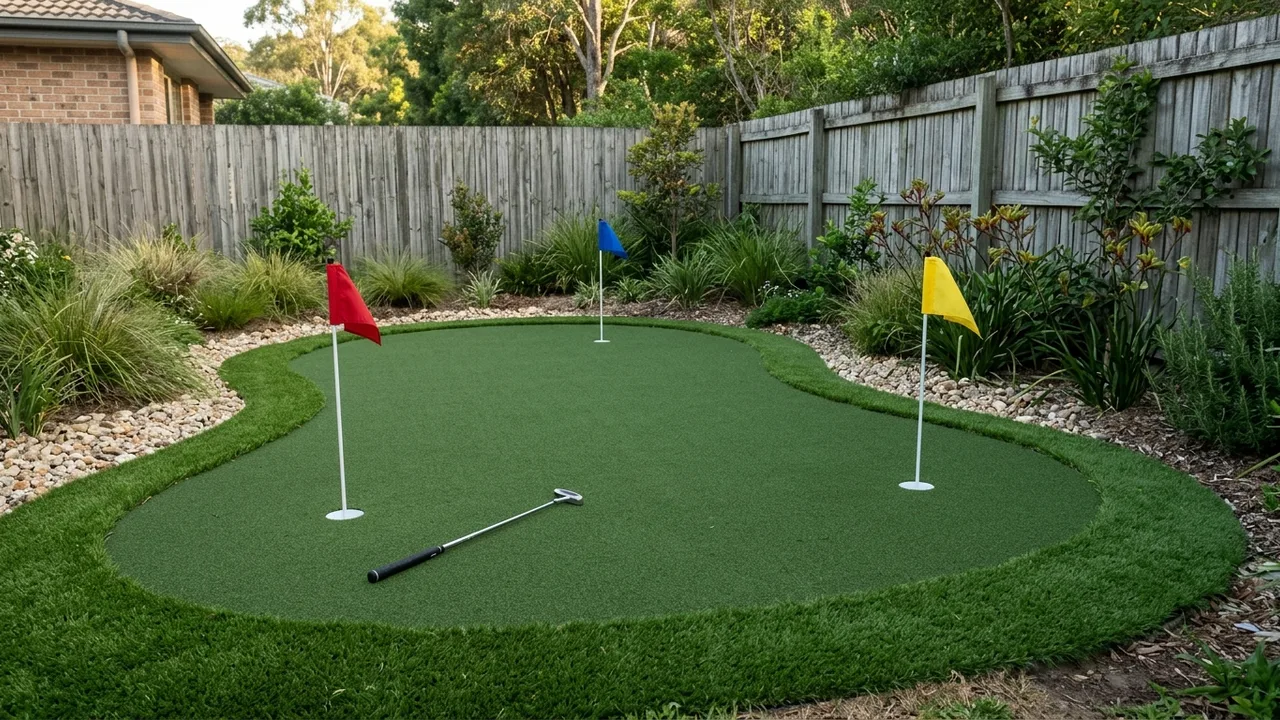
Yes, you can usually fit a proper backyard putting green in Brisbane without a huge block. A side lawn, a bare concrete patch or a tired corner may be enough for useful short putts. What matters is the shape of the space, how the ground falls and how you like to practise. An installer measures these on site and designs the green around them.
What is included
- Site measure and layout Your available length, access and ground fall decide where the cups and fringe can sensibly go.
- Clearing and excavation Old lawn, roots and soft soil come out so they cannot disturb the finished surface.
- Compacted, shaped base This layer carries the contours and keeps water moving, which protects the roll.
- Putting turf, fringe and cups Short dense turf handles putting, while the longer border slows stray balls.
- Infill and grooming Evenly brushed sand supports the fibres and settles how fast the green plays.
How it works
-
Measure and design
The installer looks at your space, hears how you like to practise and sketches the shape, cup positions and slopes.
-
Prepare the ground
Grass or debris is removed, levels are set and drainage is worked out for your soil or slab.
-
Build the contours
Base layers are spread, compacted and smoothed, with cups set into their positions.
-
Lay and finish
Turf is cut to shape, joined and fixed down, then infilled and brushed. Test putts show how it rolls.
Backyard putting green in Brisbane: will it fit your yard?
Start with the longest putt you want to hit, because that sets the size more than anything else. A compact green suits short, straight practice. A longer or wider one gives you room for several cups and some break, which is the sideways curve a ball takes across a slope.
Leave space to stand and swing the putter beyond the outer holes. A cup tucked against a fence or retaining wall is awkward to play from. The edge matters too, since a border of longer turf (called the fringe) stops balls running into garden beds.
Odd shapes can work well. A kidney curve around a pool or a narrow run beside the house can follow the lines already there. When you enquire, rough length and width are a handy start, along with what covers the area now.
What gives synthetic turf a true ball roll
A true roll comes mostly from the base. Putting turf has a short, dense pile, so it shows every dip and ridge underneath. The installer builds up crushed rock, compacts it firmly, then smooths a finer layer on top before any turf goes down.
Slopes are shaped into that base on purpose. Gentle contours make you read the line, while a flatter section lets you work on a repeatable stroke. Too much slope near a cup can leave the ball unable to stop there, so tell your installer how challenging you want it.
Sand infill is brushed down between the fibres to hold them upright. The amount and evenness affect green speed, which is how far the ball travels for a given stroke. If you want chipping as well, a softer fringe or a separate landing area needs planning from the outset.
Artificial putting surface or natural grass?
An artificial green is the lower-effort choice for home practice. A natural grass putting surface needs very close mowing, regular watering, feeding and weed control to roll well. Synthetic turf skips the mower and the hose, which also helps when water restrictions limit garden use.
Natural grass does feel different under a chip shot and stays cooler in direct sun. A synthetic surface can get hot on a summer afternoon, so a spot with some shade is more pleasant. Overhanging trees bring leaf litter, though, and that needs clearing to keep the line clean.
Portable mats are another option, especially for an office or a spare room. They cost less effort to set up and can be rolled away, but offer little shape. A built outdoor green gives you fixed cups, contours and a surface made around your space. Mini golf layouts go further, with several holes, edging and obstacles for family play.
Drainage in a subtropical climate
A well-built green lets rain soak through the turf and drain away through or off the base. If your soil is heavy clay, this needs close attention. Clay holds water after a subtropical summer downpour, and without a planned fall the base can soften and your putting line can move.
A sloping yard raises a different issue. Runoff from higher ground may cross the green, so the installer might suggest edging or a drain on the uphill side. Over concrete, water needs a way off the slab, and low spots have to be corrected before the surface is laid.
Drainage is also worth reading closely in a quote. It should set out the turf, the base preparation and how water will leave the area.
What drives the cost of a putting green installation
Size is the obvious factor, but groundwork can change the price just as much. Narrow side access means more material moved by hand. Removing old turf or concrete, building up a sloping site and shaping detailed contours all add labour.
Design choices count as well. Extra cups, a wider fringe, a chipping area and curved edges take more material or finer cutting. If your budget is firm, a smaller green on a properly built base is usually a better use of it than a large one on rushed groundwork.
Doing it yourself is possible for a basic flat mat. Shaping and compacting a base so the ball rolls true is the harder part. When hiring, look for finished putting work and a clear written scope. A putting green builder who mentions a QBCC licence can be checked on the QBCC licensee register before you pay a deposit.
Putting greens and mini golf options
- Home putting greens A practice surface with fixed cups and contours, shaped to a backyard, side yard or courtyard.
- Putting and chipping areas A green paired with fringe or a landing patch so you can work on short approach shots.
- Backyard mini golf Playful multi-hole layouts with edging and simple obstacles for children and visitors.
Putting greens and mini golf across Brisbane
Frequently Asked Questions
What is synthetic turf on a backyard putting green?
What is an artificial putting green in a backyard?
How long does it take to install an artificial putting green?
Get it priced
Patchy lawn, mud or dead grass after summer? Get a clear turf quote for your yard.
Tell us where the grass is going and get a price for your yard.